
Snowflake Tutorial for Beginners by Yuvan Infotech

What You Will Learn
- How Snowflake separates storage, compute and cloud services
- Core objects such as databases, schemas, tables and warehouses
- Practical data modelling, BI integration and interview topics
- A structured path from fundamentals to real-time projects
If you are planning to build a career in data analytics or cloud data engineering, this Snowflake tutorial for beginners provides a clear and structured starting point. It is designed for students, freshers, and professionals who want to learn modern data platforms from scratch.
Snowflake is a cloud-based data warehouse that enables organizations to store, manage, and analyze large-scale data efficiently without managing infrastructure.
At Yuvan Infotech, we offer a beginner-friendly guide to Snowflake cloud data warehouse concepts, along with real-time project training to help learners become job-ready.
Get Course Details on WhatsAppWhat Is Snowflake and What Is It Used For?
Snowflake is a modern cloud-native data platform designed to handle structured and semi-structured data. Its architecture separates storage and compute, ensuring high performance and scalability.
What is Snowflake Used For?
Snowflake is widely used for:
- Data warehousing
- Data analytics and reporting
- Secure data sharing
- Building ETL pipelines
Understanding what Snowflake is used for helps beginners align their learning with real-world applications.
Snowflake Architecture and Core Concepts
Snowflake architecture is designed to handle modern data workloads with high scalability and performance. Understanding its core components is essential for efficiently managing and processing data in real-world scenarios.
Key Components
- Databases: Store data logically
- Schemas: Organize data within databases
- Tables: Hold actual data
- Virtual Warehouses: Provide compute power
- Cloud Services: Manage metadata and security
Basic Concepts of Snowflake Platform Explained
Snowflake's architecture allows independent scaling of storage and compute. This supports better performance, cost efficiency and multiple users working simultaneously. These concepts are practised in our Snowflake course in Hyderabad.
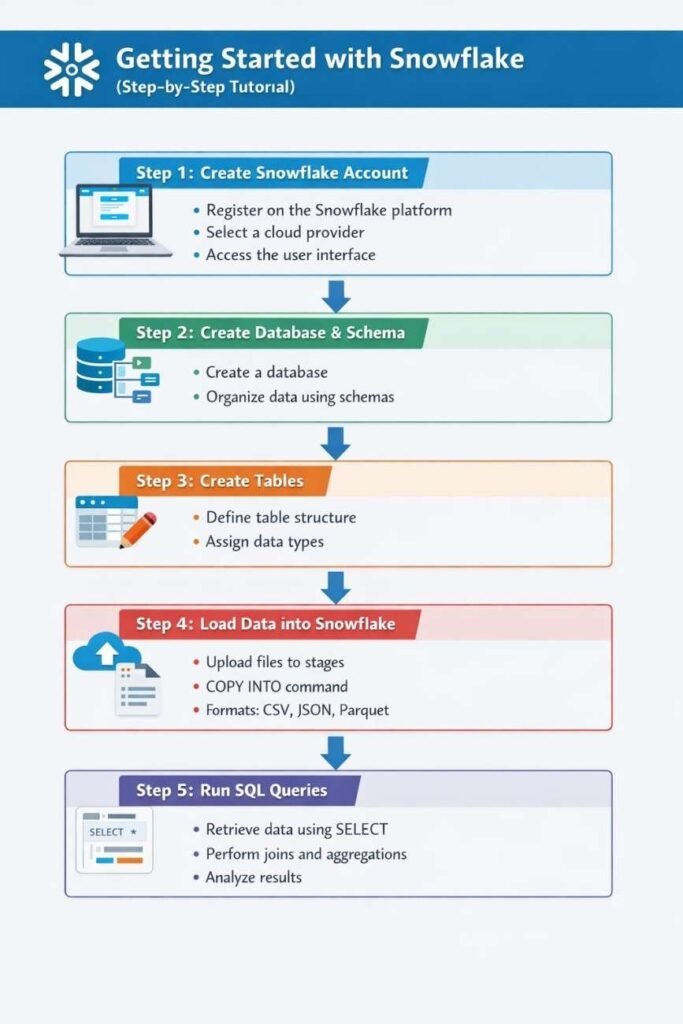
Getting Started with Snowflake (Step-by-Step Tutorial)
This flowchart provides a clear visual representation of the step-by-step process to get started with Snowflake. It simplifies the setup and data workflow, making it easier for beginners to understand and implement.
Read about our blog on Snowflake training in Hyderabad with placement support, to explore course details, real-time projects, and placement assistance offered by Yuvan Infotech.
Snowflake Data Model Example
Understanding data modeling in Snowflake is essential for organizing data efficiently and improving query performance. A well-designed data model helps in faster reporting, better analytics, and scalable data management.
Fact Tables: Fact tables store transactional data such as sales or orders.
Dimension Tables: Dimension tables store descriptive information such as customer and product details.
Real-Time Example
A simple Snowflake model example includes:
- Sales table (fact)
- Customer and Product tables (dimensions)
This structure improves reporting efficiency and query performance.
Working with Snowflake and BI Tools
Integrating Snowflake with Business Intelligence (BI) tools helps transform raw data into meaningful insights. It enables users to analyze data visually and make informed business decisions. This integration is widely used in real-time analytics and reporting.
How to Connect Power BI/Tableau with Snowflake
Snowflake integrates with:
- Power BI
- Tableau
Benefits of Integration
- Create interactive dashboards
- Generate reports
- Visualize business insights
These integrations are essential for real-time data analysis.
Snowflake Tutorial for Data Analysts and Interview Preparation
Data analysts should focus on both technical skills and practical application. Snowflake is widely used in real-world data projects, making it valuable for aspiring data professionals.
Skills Required for Data Analysts
- SQL querying
- Data transformation
- Data loading techniques
- Query optimization
Snowflake Tutorial for Interview Preparation
Focus on:
- Snowflake architecture
- Data loading processes
- SQL joins and aggregations
- Performance tuning
These topics are commonly covered in interviews and are essential for career growth.
Snowflake Certification Cost and Pricing Model
Snowflake uses a usage-based pricing model, meaning you pay only for the resources you actually consume. This approach provides flexibility and cost control for businesses.
Key Pricing Components:
- Storage cost: Charged based on the volume of data stored in the system
- Compute cost: Based on the usage of virtual warehouses to process queries
- Cloud services cost: Covers metadata management, optimization and system operations
Example:
If a company stores large datasets but runs fewer queries, storage costs will be higher while compute costs remain low. Conversely, running frequent queries increases compute usage.
This flexible pricing model makes Snowflake suitable for startups, mid-sized companies and large enterprises alike.
Why Choose Yuvan Infotech for Snowflake Training
At Yuvan Infotech, we provide:
- Real-time project-based training
- Industry-relevant curriculum
- Expert trainers
- Interview preparation support
- Placement assistance
Our training approach ensures that learners gain both theoretical knowledge and practical experience.
This Snowflake tutorial for beginners provides a complete roadmap, from understanding core concepts to implementing real-world data solutions. By following this step-by-step approach and practicing regularly, you can build a strong foundation in Snowflake and advance your career in data analytics or cloud engineering.
Contact Yuvan Infotech
Ready to start your Snowflake journey? Contact us today.
Address: 3rd Floor, Royal Arcadia Building, 303 & 404, Balkampet Rd, above SBI SME Branch, SR Nagar, Balkampet, Hyderabad, Telangana 500038
Phone: +91 63045 97668
Visit our institute or contact us to enrol in Snowflake training in Hyderabad and build your career in the data field.
Frequently Asked Questions
What is Snowflake in simple terms?
Snowflake is a cloud-based data warehouse that allows businesses to store, manage, and analyze large amounts of data without maintaining physical infrastructure. It separates storage and compute, making it scalable and easy to use.
How do I start learning Snowflake as a beginner?
To start learning Snowflake, create a free account, understand basic concepts like databases and tables, and practice SQL queries. Following a structured Snowflake tutorial for beginners with hands-on projects can speed up learning.
What are the basic concepts of Snowflake?
The basic concepts of Snowflake include databases, schemas, tables, virtual warehouses, and roles. These components help in organizing, processing, and securing data efficiently.
How is Snowflake different from traditional databases?
Snowflake differs from traditional databases by separating storage and compute, allowing independent scaling. It is also cloud-native, supports semi-structured data, and provides better performance for analytics workloads.
Is Snowflake good for data analysts?
Yes, Snowflake is commonly used by data analysts to work with large volumes of data. It helps in running queries, transforming data, and performing detailed analysis. It also connects easily with popular BI tools and supports advanced SQL features, making it a strong choice for analytics work.
What are the advantages of using Snowflake?
Snowflake provides flexible scaling, fast performance, secure data sharing, and a cost-effective pay-as-you-go pricing model. These benefits make it a good option for both startups and large organizations.
Can I learn Snowflake without SQL?
Having basic SQL knowledge is helpful, but beginners can start learning Snowflake and SQL at the same time. Since most tasks in Snowflake use SQL, learning both together will make the process easier.
What is a virtual warehouse in Snowflake?
A virtual warehouse in Snowflake is a computing resource that runs queries and handles data processing tasks. It can be adjusted in size based on the workload to ensure better performance and efficiency.