
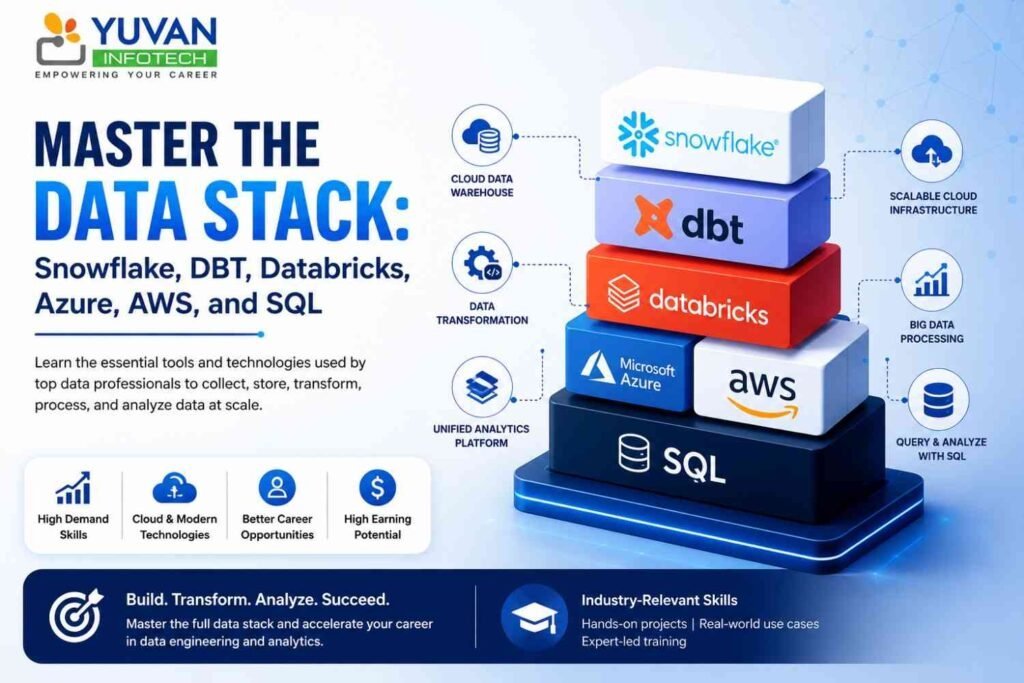
How the Modern Data Stack Works
Data is the backbone of modern business, powering analytics, artificial intelligence, and strategic decision-making. As organizations continue to adopt cloud-based technologies, the demand for professionals skilled in modern data platforms is growing rapidly.
Technologies such as Snowflake, DBT, Databricks, Azure, AWS, and SQL have become essential components of today’s data ecosystem. Together, they help businesses collect, store, transform, and analyze data efficiently at scale.
For aspiring data engineers, cloud professionals, and analytics specialists, mastering these tools can open doors to high-demand career opportunities across industries. This guide explores the modern data stack, the role of each technology, and how learning these in-demand skills can help you build a successful and future-ready career in data engineering.
Understanding the Modern Data Stack and Why It Matters
The modern data stack refers to a collection of cloud-based technologies that work together to collect, store, transform, process, and analyze data. Unlike traditional on-premises systems, modern data stacks are highly scalable, flexible, and optimized for real-time business needs.
What Is a Modern Data Stack?
A modern data stack typically includes:
- Data ingestion tools
- Cloud storage platforms
- Data warehouses
- Data transformation frameworks
- Analytics platforms
- Business intelligence tools
- Machine learning environments
The primary goal of a modern data stack is to create a streamlined data pipeline that enables organizations to move data from source systems to actionable insights quickly and efficiently.
Why Businesses Are Adopting Modern Data Architectures
Organizations generate massive amounts of data from:
- Websites
- Mobile applications
- Customer interactions
- Financial systems
- IoT devices
- Marketing platforms
- Enterprise applications
Traditional systems often struggle to handle this growing volume of information. Modern cloud-native technologies solve this challenge by providing scalable infrastructure and advanced analytics capabilities.
Benefits of Mastering the Modern Data Stack
Professionals who understand modern data technologies can:
- Build scalable data pipelines
- Manage enterprise data platforms
- Improve data quality
- Support business intelligence initiatives
- Enable machine learning projects
- Optimize cloud infrastructure
This combination of skills makes data professionals highly valuable across industries including healthcare, finance, retail, manufacturing, telecommunications, and technology.
Snowflake and DBT: Building Scalable Data Warehouses and Transformation Pipelines
Modern organizations require a reliable way to store and transform data before it can be used for analytics and reporting. Snowflake and DBT have emerged as two of the most popular technologies for this purpose.
What Is Snowflake?
Snowflake is a cloud-native data platform designed for data storage, processing, sharing, and analytics. Unlike traditional data warehouses, Snowflake separates storage and compute resources, allowing organizations to scale workloads independently.
Key Features of Snowflake
- Multi-cloud compatibility
- Automatic scaling
- Secure data sharing
- High performance analytics
- Cost optimization
- Built-in security controls
Because of its flexibility and ease of use, Snowflake has become a preferred data warehouse solution for enterprises worldwide.
Why Companies Choose Snowflake
Organizations use Snowflake because it simplifies data management while supporting complex analytical workloads.
Benefits include:
- Faster query performance
- Reduced infrastructure management
- Improved collaboration
- Simplified data governance
- Support for structured and semi-structured data
What Is DBT?
DBT (Data Build Tool) is a transformation framework that allows data teams to manage data transformations directly within cloud data warehouses.
DBT enables teams to:
- Write reusable SQL models
- Document transformations
- Perform automated testing
- Implement version control
- Create reliable data workflows
Why DBT Is Becoming Essential
Modern analytics teams increasingly adopt software engineering practices. DBT bridges the gap between data engineering and analytics by introducing:
- Code-based transformations
- Testing frameworks
- Continuous integration workflows
- Documentation automation
Skills Learned Through Snowflake and DBT Training
A comprehensive Snowflake and DBT course typically covers:
- Data warehouse architecture
- Data modeling
- SQL development
- Transformation workflows
- Incremental processing
- Data quality testing
- Analytics engineering concepts
Professionals with Snowflake and DBT expertise are highly sought after because organizations need scalable and reliable data platforms to support decision-making.
Databricks: The Engine Behind Big Data, Analytics, and AI
As data volumes continue to grow, organizations require platforms capable of processing large-scale datasets efficiently. Databricks has become one of the leading solutions for big data analytics and machine learning.
What Is Databricks?
Databricks is a unified data analytics platform built on Apache Spark. It provides an environment where data engineers, analysts, and data scientists can collaborate on large-scale data projects.
Databricks supports:
- Data engineering
- Data science
- Machine learning
- Real-time analytics
- Data lakehouse architectures
Why Databricks Is Important in Modern Data Engineering
Traditional analytics platforms often separate storage, processing, and machine learning environments. Databricks combines these capabilities into a unified platform.
This allows organizations to:
- Reduce data silos
- Accelerate analytics
- Improve collaboration
- Simplify machine learning workflows
Understanding the Lakehouse Architecture
One of Databricks’ major innovations is the Data Lakehouse.
A Lakehouse combines the benefits of:
Data Lakes
- Flexible storage
- Large-scale data retention
Data Warehouses
- Structured analytics
- Governance controls
- Query optimization
This hybrid architecture enables organizations to manage both analytics and AI workloads from a single platform.
Databricks Skills Employers Value
Professionals trained in Databricks often learn:
- Apache Spark
- PySpark
- Delta Lake
- Data Lakehouse design
- Streaming analytics
- Machine learning workflows
- Performance tuning
Career Opportunities with Databricks
Databricks expertise can lead to roles such as:
- Data Engineer
- Big Data Engineer
- Analytics Engineer
- Machine Learning Engineer
- Cloud Data Architect
As organizations continue investing in AI initiatives, Databricks skills are becoming increasingly valuable in the global job market.
Azure and AWS: The Cloud Foundations of Modern Data Engineering
Cloud computing has transformed how organizations store, process, and manage data. Microsoft Azure and Amazon Web Services (AWS) dominate the cloud market and play a critical role in modern data engineering.
Why Cloud Skills Are Essential
Most enterprise data systems now operate in cloud environments because cloud platforms provide:
- Scalability
- Reliability
- Security
- Cost efficiency
- Global availability
Understanding cloud infrastructure is therefore a fundamental requirement for modern data professionals.
Microsoft Azure for Data Engineering
Azure offers a comprehensive ecosystem for data integration, storage, analytics, and machine learning.
Popular Azure data services include:
- Azure Data Factory
- Azure Data Lake Storage
- Azure Synapse Analytics
- Azure Databricks
- Azure SQL Database
Azure Data Engineering Use Cases
Organizations use Azure for:
- Enterprise data warehousing
- ETL and ELT pipelines
- Real-time analytics
- Business intelligence
- AI and machine learning projects
Amazon Web Services (AWS) for Data Engineering
AWS remains the largest cloud provider globally and offers extensive services for data processing and analytics.
Key AWS services include:
- Amazon S3
- AWS Glue
- Amazon Redshift
- Amazon Athena
- AWS Lambda
- Amazon EMR
Why AWS Skills Are Highly Valued
AWS supports organizations of all sizes and industries.
Professionals with AWS expertise can:
- Design cloud architectures
- Build scalable pipelines
- Process large datasets
- Automate workflows
- Support analytics platforms
Azure vs AWS: Which Should You Learn?
Both platforms offer excellent career opportunities.
Choose Azure if:
- You work with Microsoft-focused organizations
- Your company uses Azure infrastructure
- You want to specialize in enterprise environments
Choose AWS if:
- You want broader cloud exposure
- You work with startups or global enterprises
- You want experience with the largest cloud ecosystem
Many successful data engineers ultimately learn both platforms because organizations increasingly operate in multi-cloud environments.
SQL: The Core Skill That Powers Every Data Professional
While cloud platforms and modern tools receive significant attention, SQL remains the most important foundational skill in data engineering.
Virtually every data engineering workflow involves querying, transforming, or analyzing data using SQL.
What Is SQL?
SQL (Structured Query Language) is the standard language used to interact with relational databases and data warehouses.
It allows professionals to:
- Retrieve information
- Transform datasets
- Aggregate metrics
- Create reports
- Manage database objects
Why SQL Remains Critical
Regardless of the platform being used-Snowflake, Databricks, Azure, or AWS-SQL remains the primary language for working with data.
Many organizations evaluate SQL proficiency during technical interviews because it directly reflects a candidate’s ability to solve real-world data challenges.
Advanced SQL Concepts Every Data Engineer Should Learn
A strong SQL curriculum should include:
- Joins
- Window functions
- Subqueries
- Common Table Expressions (CTEs)
- Aggregations
- Query optimization
- Data manipulation techniques
SQL and Data Modeling
Data engineers must also understand how data is structured.
Important concepts include:
- Fact tables
- Dimension tables
- Star schemas
- Snowflake schemas
- Normalization
- Denormalization
These principles help organizations build efficient reporting and analytics systems.
How SQL Connects the Entire Data Stack
SQL serves as the common language across:
- Snowflake
- DBT
- Azure Synapse
- Amazon Redshift
- Databricks SQL
- Data Warehouses
Because of this, strong SQL skills accelerate learning across every other technology in the modern data stack.
Common Interview Questions About SQL
Many employers assess candidates on:
- Query performance optimization
- Complex joins
- Window functions
- Data transformation logic
- Data modeling scenarios
Professionals who master SQL often progress more quickly into advanced engineering and architecture roles.
How to Master the Complete Data Stack and Future-Proof Your Career
Learning individual technologies is valuable, but understanding how they work together creates the greatest career advantage.
Recommended Learning Path
A practical progression includes:
- SQL Fundamentals
- Data Warehousing Concepts
- Cloud Basics (Azure or AWS)
- Snowflake Architecture
- DBT Transformations
- Databricks and Apache Spark
- End-to-End Data Pipeline Projects
Focus on Hands-On Experience
Employers increasingly prefer candidates who can demonstrate practical skills.
Build projects such as:
- Cloud-based data warehouses
- Automated ETL pipelines
- Real-time analytics dashboards
- Data transformation workflows
- Lakehouse architectures
Develop a Portfolio
A strong portfolio demonstrates your ability to:
- Design solutions
- Solve business problems
- Work with modern tools
- Implement best practices
Portfolio projects often help candidates stand out during interviews.
Stay Updated with Industry Trends
The data landscape evolves rapidly. Professionals should continuously learn about:
- AI integration
- Data governance
- Data observability
- Data mesh architectures
- Real-time processing
- Advanced analytics
Conclusion
Mastering the modern data stack is one of the most effective ways to build a successful career in today’s technology landscape. Organizations increasingly depend on data-driven decision-making, creating strong demand for professionals who can design, manage, and optimize data platforms.
Technologies such as Snowflake, DBT, Databricks, Azure, AWS, and SQL each play a unique role within modern data ecosystems. Together, they enable businesses to collect, transform, store, analyze, and leverage data at scale.
At Yuvan Infotech, we offer both options, and our program is designed to deliver the same quality and practical exposure.
Contact Yuvan Infotech
Ready to start your journey with the best Snowflake Institute in Hyderabad? Get in touch with us today and book your demo session.
Address: 3rd Floor, Royal Arcadia Building, 303 & 404, Balkampet Rd, above SBI SME Branch, SR Nagar, Balkampet, Hyderabad, Telangana 500038
Phone:
+91 6304597668
Email:
hr@yuvaninfo.com
Visit our institute or contact us today to enroll in the Snowflake Training course in Hyderabad and build your career in the data field.