
Snowflake vs Traditional Data Warehouses: Complete Comparison
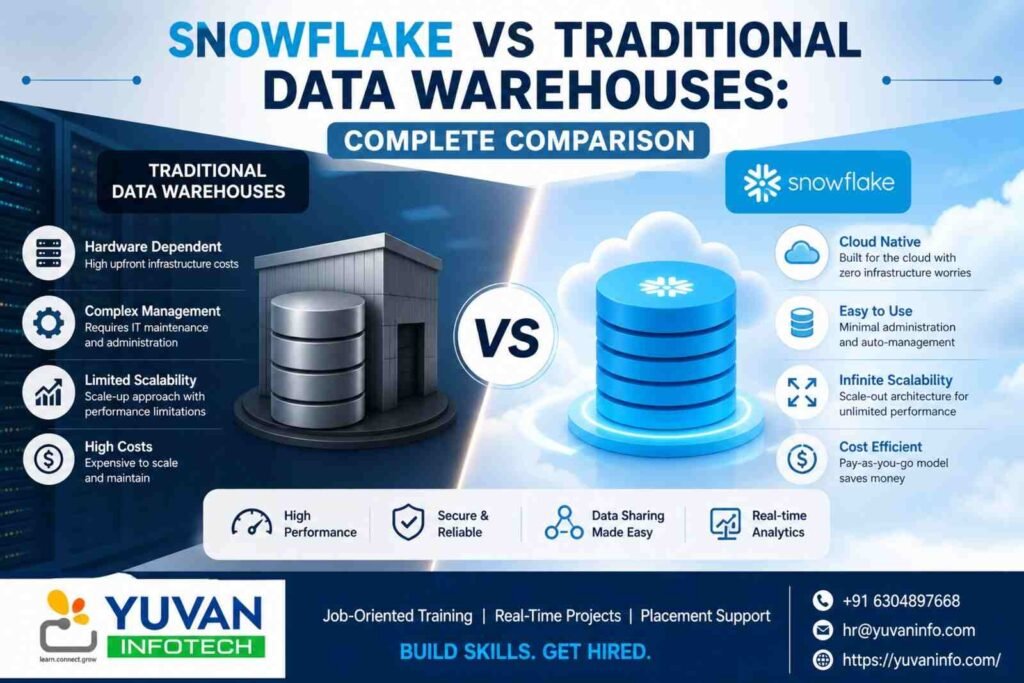
As organizations increasingly rely on data to drive strategic decisions, the choice of a data warehousing solution has become a critical factor in business success. Traditional data warehouses such as Oracle, Teradata, and SQL Server have long dominated the landscape. However, the emergence of Snowflake, a cloud-native data platform, has significantly disrupted this space.
In 2026, businesses are rapidly transitioning from legacy systems to modern cloud-based solutions, with Snowflake leading the way. Snowflake vs Traditional Data Warehouses This article provides a comprehensive comparison between Snowflake and traditional data warehouses, helping professionals and organizations understand which solution best meets their needs.
Understanding Traditional Data Warehouses and Snowflake
Traditional data warehouses are designed for structured data and usually require on-premise infrastructure or dedicated servers. They involve complex setup, high initial investment, and ongoing maintenance. Snowflake, in contrast, is a cloud-native platform that simplifies deployment and eliminates hardware dependency.
- Traditional warehouses require physical infrastructure and manual setup
- Snowflake is fully managed and runs on cloud platforms
- Legacy systems are less flexible in handling dynamic workloads
- Snowflake supports both structured and semi-structured data
- Faster deployment and minimal configuration in Snowflake
Key Differences in Architecture and Performance
The architecture of a data warehouse directly impacts its performance and scalability.Snowflake vs Traditional Data Warehouses Traditional systems use tightly coupled storage and compute resources, which can limit efficiency. Snowflake separates these components, enabling better workload management and faster query execution.
- Traditional systems face performance issues with concurrent users
- Snowflake allows multiple workloads without performance impact
- Manual tuning and indexing are required in legacy systems
- Snowflake automates optimization and query performance
- Supports modern data formats like JSON, Parquet, and Avro
Cost, Scalability, and Maintenance Comparison
Cost and scalability are major decision factors for businesses. Snowflake vs Traditional Data Warehouses Traditional warehouses involve high upfront costs and complex scaling processes. Snowflake’s usage-based pricing and instant scalability provide a more cost-effective and flexible solution.
- High capital investment required for traditional systems
- Snowflake uses pay-as-you-go pricing
- Scaling in traditional systems requires downtime
- Snowflake scales instantly without disruption
- Minimal maintenance required with Snowflake
- Reduced operational overhead compared to legacy systems
Use Cases, Security, and Future Outlook
Both solutions have their place depending on business needs. Traditional warehouses suit stable environments, while Snowflake excels in modern, data-driven use cases. With built-in security and continuous innovation, Snowflake vs Traditional Data Warehouses Snowflake is shaping the future of data warehousing.
- Traditional systems are suitable for predictable workloads
- Snowflake supports real-time analytics and data sharing
- Built-in security features like encryption and access control
- Ideal for industries handling large and diverse datasets
- Strong future growth due to cloud adoption trends
Conclusion
The shift from traditional data warehouses to Snowflake represents a major evolution in data management. While legacy systems still serve certain use cases, they lack the flexibility and scalability required in today’s fast-paced environment. Snowflake offers a modern, Snowflake vs Traditional Data Warehouses efficient, and cost-effective alternative that aligns with current and future business needs.
Build a future-ready career with expert-led Snowflake and Data Engineering training at Yuvan Infotech, designed for real-time industry skills.